
Drawquarium Fish Care and Feeding Guide
Keep hunger low and the tank clean in Drawquarium: how feeding, drawn food, leftovers, bottom feeders, and the vacuum actually fit together.
Fish care in Drawquarium is a hygiene loop, not a stat grind. You feed a fish, the fish eats, some food is missed, the leftovers become debris, and you vacuum the tank. The September update made that debris persistent, which turned cleaning from a visual detail into a real task. This guide covers the loop in the order it happens, with the parts the game confirms and the parts it leaves to you.
Well-fed fish are the prerequisite for breeding→.
Hunger is a ring, not a timer
The fish card shows a circular hunger indicator around a feed icon. There is no published feeding cooldown or decay rate, so do not schedule meals by the clock. Check the card, feed when the ring is low, and stop when the fish stops eating. That is the whole rule.
The card also shows level, age in days, and a personal quote. The quote is flavor, but it is a useful tell: a fish that has just been fed often has a different animation than a hungry one. Watch the tank for a minute after feeding and you will start to recognize the difference.
Draw the food, do not buy it
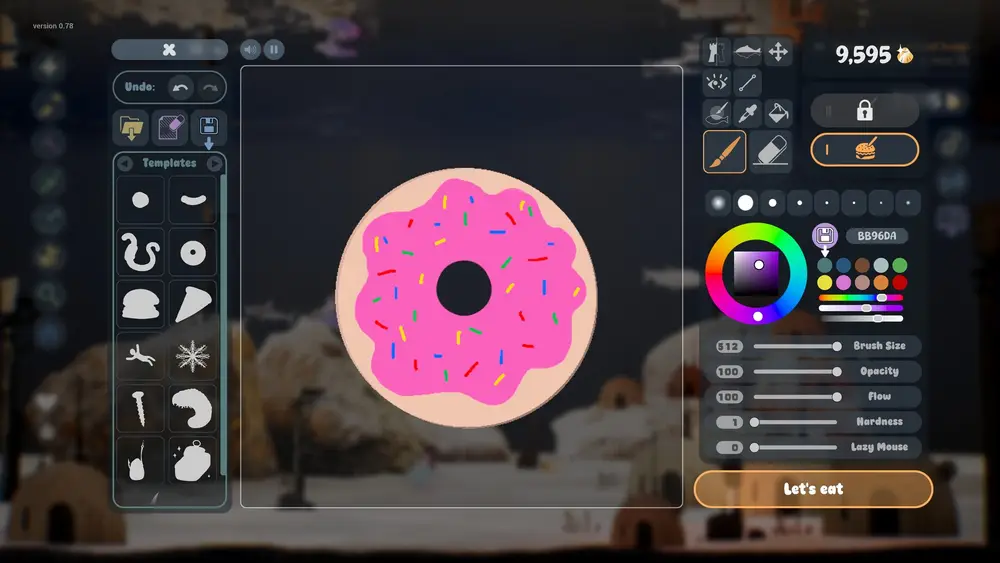
Food comes from the food editor. The template row includes simple shapes: a circle, a banana, a snake, a donut, a snowman. The brush defaults in the screenshot are large (size 512, hardness 1), which suits bold shapes that read at tank distance.
Draw one food you will use regularly and save it. A donut is not more nutritious than a circle; the shape is cosmetic. What matters is the size of the piece relative to the fish. A piece that is too large gets nibbled and abandoned, and the remainder sinks.
Feed in small portions
The reliable pattern is three small meals instead of one large one:
- Drop a small piece near the fish you want to feed.
- Wait for it to eat.
- Drop another piece only if the hunger ring is still low.
- Vacuum whatever reaches the substrate.
This keeps the tank readable and keeps bottom feeders useful. It also makes it obvious when a fish is not eating, which is the first sign that something in the tank is wrong.
Bottom feeders are support, not a vacuum
The demo page lists bottom-feeding fish that only eat leftover food. They are genuinely useful: a bottom feeder will clean the substrate while you work on something else. They are not a replacement for the vacuum, because food that lands on decor, plants, or the water column stays there.
A good ratio is one bottom feeder for every four or five mid-water fish. More than that and the bottom feeder runs out of work; fewer and the substrate accumulates.
The vacuum and the muck
The aquarium vacuum removes leftover food and debris. The September post mentions cleaning leftover food and muck, and the demo page lists the same job. Use it after every feeding session, not once a day. A clean tank is easier to look at, easier to screenshot, and easier to run as a wallpaper.
If you see a haze or a cluster of particles, vacuum that area first. Do not rearrange decor until the water is clear; moving a rock stirs up whatever settled behind it.
Do not leave a large meal in the tank before switching to wallpaper mode. The mode hides the interface, so the mess keeps building while you are working on something else.
Plants, light, and water quality
The store page lets you draw plants and adjust lighting. There is no published water-chemistry system, so plants are decor and habitat rather than filtration. That said, a planted tank hides debris better and gives fish places to swim around, which makes the tank feel alive.
Keep the plant count moderate. A wall of plants obscures the fish and makes it hard to spot a hungry one.
Relationships and stress
Fish react to food, bubbles, new fish, and changes in the environment. The September post says they can get excited or scared. A new large fish can unsettle a small tank, and a tank with no cover can make fish skittish.
If a fish stops eating after a change, undo the change: remove the new decor, turn the lights down, or move the new fish to another tank. The game does not publish a stress meter, so behavior is the meter.
A daily routine that scales
For one tank:
- Morning: check cards, feed small portions, vacuum.
- Midday: collect floating scales, check goals.
- Evening: one more feeding pass, vacuum, then wallpaper mode if you want it.
For two tanks, do the maintenance pass on both before you start drawing. Drawing is the reward; cleaning is the gate.
What good care actually earns
Good care produces the visible rewards the developer has described: metallic shimmer as fish age, golden fish for well-kept specimens, babies from healthy pairs, and medals on the fish card. None of those are tied to a published score. The safest strategy is consistency rather than optimization.
Official source: Drawquarium store page ↗ and the demo page ↗, rokaplay ↗ and the Drawquarium Discord ↗

FAQ
How often should I feed fish?
There is no published interval. Feed when the hunger ring is low and stop when the fish stops eating. Small, frequent meals beat one large one.
Why is food staying on the sand?
Either the fish are full, the pieces are too large, or the food landed away from the fish. Vacuum it and try a smaller piece next time.
Do bottom feeders eat all leftovers?
They eat leftover food that reaches the substrate. They do not clean the water column, plants, or decor. Keep using the vacuum.
Can a fish die from hunger?
No death state is described on the store page. A hungry fish is unhappy and may stop producing rewards, but the game is not built around losing fish.
More Drawquarium Guides
How levels, days old, medals, metallic shimmer, and golden fish work in Drawquarium, and what the level 25 goal actually asks for.
A Drawquarium fish list built from official screenshots and patch notes: body templates, bottom feeders, jellyfish, sharks, and golden fish.
Use Drawquarium as a focus companion: the clock, timer, journal, checklist, and wallpaper mode, plus a simple work session setup.
How the Drawquarium food editor works, which shapes to draw, how portion size affects leftovers, and why bottom feeders still need the vacuum.
A practical Drawquarium guide for the first hour: draw a fish that reads well, feed it, finish early goals, and unlock your first upgrades.
Where Drawquarium runs: Windows PC requirements, Mac and Linux answers, Steam Deck compatibility, mobile, and console availability.
Drawquarium's price has not been announced. What is confirmed, how regional pricing works, whether it is free, and how to avoid overpaying.
Drawquarium launches on November 13, 2026 for Windows on Steam. What is confirmed about the release, the trailer, wishlists, and launch day.